




In Northern Nigeria, the ancient tradition of Gara provides a critical economic lifeline for newlyweds. By supplying essential food items to the couple, the bride’s family eases the groom’s financial burden, helping new homes survive and rebuild their finances amidst Nigeria’s record-high food inflation and ongoing currency crisis.
By Abdulaziz Bagwai
*Musa Abdullahi, 27, owned a provision store in Gwaram, a town nestled in Jigawa State, northwest Nigeria, where he sold foodstuffs and daily essentials to his community. His profits plummeted just a few weeks before tying the knot with his heartthrob, *Sakina Muhammad. He found it impossible to pay the electricity bill for his rented apartment, coming shortly after his mother had intervened to cover his water bill. He explained that the collapse of his business was due to the heavy burden of wedding expenses, all of which he settled alone. “I had no other source of income apart from the shop.”
While most bridegrooms are happy and social in the weeks leading up to their wedding, Abdullahi was different. Since his business failed, he hadn’t been himself. He worried constantly about where to get the food his new family would need. He even considered taking the remaining stock from his shop for his new home, but he had already sold out most of the essentials which he could no longer afford, such as rice, oil, beans, pasta, and flour.
One Thursday night in 2022, a week before the wedding, Abdullahi and his friend, Nasiru Bala, sat at a Maishayi joint in their community to have dinner, which Bala paid for. They were discussing the wedding plans—skipping many traditions they deemed “unimportant” because Abdullahi was completely broke and hoping for a miracle to ease his burden. “He had entirely forgotten about Gara until I reminded him. He was so excited that I saw tears of joy on his face,” Bala told Nations Voice.
The Tradition and How It’s Been Done
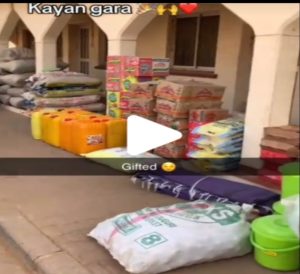
Gara is a tradition in Northern Nigeria’s Hausa communities where the bride’s parents provide sufficient food items to the new couple. It is their contribution to the groom—who takes over responsibilities of their daughter—to reduce the burden of grocery shopping in the early days of marriage. The arrangement of Gara varies by community. For example, in the Kano North region, the bride’s family donate food items to the bride’s parents, bringing whatever raw food they have, such as rice, millet, maize, beans, flour, pasta, spices and oil. These collective donations, combined with contributions from the bride’s parents, create an abundance of provisions that can last the couple a long time.
In most low-income families, donations start early to give those without reserved items time to prepare. In rural communities, neighbors and relatives carry these items to the bride’s home in basins and calabashes balanced on their heads. But in urban places like Kano metropolis, Gara of well-to-do families are transported by vehicles due to the quantity, and unlike in rural communities, family relatives in urban communities often give monetary donations instead of food items—allowing the bride’s parents to purchase their desired items.
Dr. Alamuna Nuhu of the Department of Nigerian Languages at Kaduna State University (KASU) explained that Gara, just like many other Hausa customs, lacks proper documentation, making it hard to trace exactly when it began. He further noted that while the culture has modernized, it still remains an essential support system that helps grooms rebuild their finances after the heavy spending of a wedding. “The groom doesn’t have to worry about buying foodstuffs for weeks or months after marriage, which provides an opportunity for him to focus on rebuilding his business,” he noted.
Nigeria faced a severe food crisis between October 2023 and March 2024, with inflation rising from 31.51% to 40.1%. This was largely due to the depreciation of the Naira, which hit an all-time low of over ₦1,600 to the US Dollar. However, according to the National Bureau of Statistics, the average price of 1kg of local rice rose to ₦1,340.74 in March 2024—a massive jump from the ₦530.08 recorded in March 2023. The high exchange rate and security challenges in Northern Nigeria have driven up the price of both local and imported food, increasing hunger across the country.
While Gara Is A Cherished Heritage, Competition Has Crept In
Two weeks after his wedding, Abdullahi started preparing to move to Southern Nigeria because, as he said, business opportunities were broader there, and since his capital was gone, he had no reason to stay. Before his trip, a friend mocked him by suggesting he go to Ibadan because his father-in-law did business there. “Maybe the two of you could raise money to pay the debt your father-in-law owes me,” Abdullahi recalled his friend, Saminu Lawal, saying. He further said he had no idea his in-laws had gone into debt just to provide him with such a rich Gara, but made it upon himself to clear the debt for his in-law when he resume home from Lagos where he would work as an Okada.
When the bride’s father, *Muhammad Kabiru, heard of the encounter, he expressed deep shame for taking on burdens beyond his means. He advised others in his position to stay within their limits. “I never expected that from Saminu. I always bought oil from him. I was bankrupt during my daughter’s wedding and had arranged everything for her Gara except the cooking oil. I took it on credit from him, but I’ve learned my lesson.”
Rakiya Musa, a cousin of the bride, also recalled an acquaintance mentioning the struggle to provide five mudus of maize as a donation. “She felt she must do it because she also has a daughter getting married soon.”
While Gara is a heritage, competition has crept in. Families and neighbors now compete over who provides the best Gara, which is often influenced by the dowry paid and quality of the Lefe—the purchases of luxury items, including clothing, perfumes, jewelry, and cosmetics—to the bride before the wedding, which symbolizes commitment and the groom’s capability to care for his wife. This competition leads to long preparation times and unpredictable wedding postponements.
Furthermore, some young men now target daughters of the wealthy specifically to receive truckloads of food, which indirectly promotes laziness. Experts like Dr. Nuhu predict that those who marry for these benefits often end up in divorce or flee when they can no longer afford to feed their spouses, contributing to rising divorce rates.
Dr. Nuhu further stated that cultures are better when practiced as inherited, without being distorted by modernization or personal greed. “It is unfortunate that families now see Gara as so mandatory that weddings are postponed if it isn’t ready.” He advised the Hausas to uphold their culture but cautioned against taking on burdens that exceed their capacity.
Note: Names marked with (*) asterisks are pseudonyms changed to protect the identities of the sources.
I enjoyed reading this. I’ve heard about Gara but I thought it had to do with things like furniture, beddings, kitchen utensils and home decor. I didn’t know food was the main thing
Many people shared this perspective with you, and this is why to us – The Nation Voice – spotlighting underreported stories matter. Because we want people to be well-informed about things that matter in Africa.