





By Editor.
In a bid to strengthen professionalism in judicial reportage, the Sokoto State Council of the Nigeria Union of Journalists (NUJ) has trained media practitioners on accurate court reporting and ethical news writing, stressing the role of credible journalism in safeguarding justice and public trust.
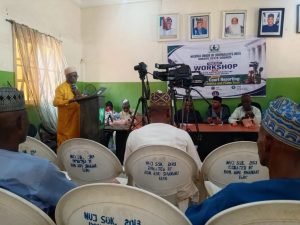
The one-day workshop, held on Saturday at the NUJ Press Centre along Zuru Road in Sokoto, brought together journalists from different media organisations under the theme, “Accurate Court Reporting: A Pillar of Justice and Public Trust.”
Speaking during the opening session, the Chairman of the NUJ in Sokoto State, Comrade Usman Muhammad Binji, said the initiative was designed to equip journalists with the necessary knowledge and skills required for balanced, fair and factual reporting of judicial proceedings.
He noted that despite the importance of judicial journalism in society, the beat has remained one of the most neglected areas of reporting.
According to him, the union considered it necessary to revive interest in legal reportage and encourage the restoration of judicial desks in media houses.
Binji expressed optimism that the workshop would inspire journalists to approach court reporting with greater professionalism and responsibility.
Also speaking, the Sokoto State Commissioner for Information and Orientation, Sambo Bello Danchadi, commended the NUJ for organising the training, describing it as timely and relevant in an era where misinformation can easily undermine public confidence in institutions.
He urged journalists to sustain the ethics of fairness and accuracy while covering legal matters, emphasizing that judicial reporting requires a sound understanding of legal procedures and careful interpretation of court proceedings.
Danchadi further encouraged participants to maximize the opportunity provided by the workshop in improving the quality of legal and court-related reports across the state.
Delivering one of the keynote presentations, media expert and Founder/CEO of ASHENEWS, Abdallah ELKUREBE, described court reporting as one of the most delicate aspects of journalism, warning that a single mistake in a judicial story could damage reputations, misinform the public, or expose journalists and media organisations to legal actions.
He explained that judicial journalism serves as a bridge between the courts and the public by helping citizens understand legal decisions, court proceedings and issues relating to justice and accountability.
According to him, court reporting extends beyond criminal trials to include civil cases, constitutional matters, corruption allegations, election petitions and human rights cases.
ELKUREBE stressed that a competent court reporter must possess qualities such as accuracy, patience, neutrality, professionalism, strong listening ability and a good grasp of legal terminology.
During the session, participants were also taken through the structure of Nigeria’s judicial system, including the Supreme Court, Court of Appeal, Federal and State High Courts, Magistrate Courts, Sharia Courts and Customary Courts.
The media trainer advised journalists to familiarize themselves with common legal expressions such as “plaintiff,” “defendant,” “adjournment,” “conviction,” “acquittal,” and “appeal” to avoid factual and legal errors in their reports.
He also underscored the importance of respecting the principle of presumption of innocence, cautioning journalists against portraying suspects as criminals before a court pronounces judgment.
“Using the right legal language protects journalists from issues of defamation and contempt,” he said.
The workshop further examined ethical and legal challenges confronting court reporters, including contempt of court, sensational headlines, publication of unverified information and biased reporting capable of influencing judicial processes.
Participants were encouraged to verify names, dates and facts before publication, maintain detailed notes during proceedings and remain calm and professional while covering cases.
The growing impact of digital and social media on judicial reporting also formed part of the discussions, with speakers warning journalists against sacrificing accuracy for speed in the race to break news online.
The training concluded with a renewed call for responsible journalism, as participants were reminded that credible court reporting remains vital to democracy, accountability and public trust in the justice system.