

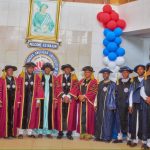
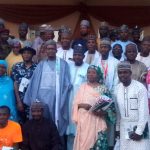
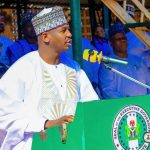
 Section of participants at the KAPFEST 2.0
By Abdulaziz Bagwai
Kano, Nigeria: It’s Friday, September 12, 2025; the sun had just risen over with a humming smile, dust spilling around. I marched down from my residence to The Avenue Event Center at Murtala Muhammad Way.
The streets, alive with noises of vehicles, mostly tricycles, polluting the air with black smoke. The sky – angrily cloudy with its soft beauty as if the heavens knew a gathering of voices was about to shake the earth – stretched across my sight. The venue thrummed with joy as participants, guests, and the organizing committee from the Poetic Wednesdays Initiative darted about banners with bold calligraphy that read “Kano International Poetry Festival (KAPFEST) 2025.”
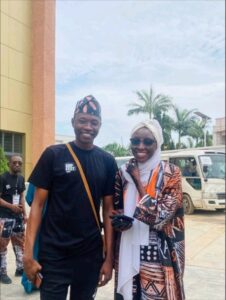
The curators, Salim Yunusa and Nasiba Babale
The festival, co-curated by Nasiba Babale and Salim Yunusa, both renowned Nigerian poets, welcomed diverse creatives – poets, writers, authors, academics… – public and influential figures from across the country. Notably, the Emir of Kano – Sunusi Lamido Sunusi II; Mr. Dike Chukwumerije – a Nigerian, internationally acclaimed stage poet and author; BM Dzukogi – the lead convener of HIASFEST who was awarded a lifetime award for his immense contribution in promoting literary activities across the region; Prof. Malumfashi Ibrahim – a seasoned professional championed for his remarkable knowledge and contribution in documenting the rich Hausa history and literature; Umar Abubakar Sidi – a poet and novelist, most recently known for his book “The Incredible Dreams of Garba Dakaskus”; Richard Ali; Star Zahra; and many other brilliant writers.
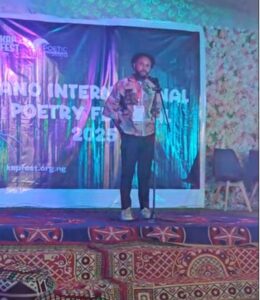 Toby Abiodun opening the stage with a performance
Starting with performances by Toby Abiodun and Hidaaya Mahmud, the hall embedded with flailing curtains was filled with cheers from the audience. I watched, mouth agape, as the large standing fans blew with full forces while the fridge-looking, standing air conditioners moisturized the air with coolness.
Nasiba Babale, the festival’s co-curator who is also the Creative Director of the Poetic Wednesdays Initiative, stood at the entrance, her eyes filled with tears of joy and fulfillment that her year-long plan was unfolding. And I hear words of admiration and compliments from someone near me. He said “I can’t believe a woman did this!” and continued, “She deserves all the roses in this world.”
Poetry in the Time of Crisis
This year’s theme – Poetry in Time of Crisis – explored how northern Nigeria is grappling with various security, socio-economic, and political challenges. KAPFEST brings together poets, scholars, and creatives to reflect on these challenges and envision a better future through artistic expression.
The Emir of Kano, Muhammadu Sanusi II, on his panel session titled “Beyond Words: Unlocking Northern Nigeria’s Literacy Potential,” emphasized the need for effective governance, criticizing Nigeria’s focus on ethnic and religious divisions while global conversations revolve around pressing issues like climate change and artificial intelligence.
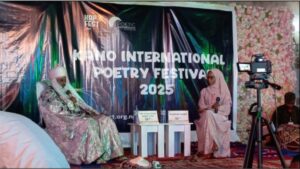
Emir Sunusi and his daughter, Khadija Yusrah Sunusi on a panel session
The Emir further challenged the Nigerian government to prioritize strengthening the educational sector of the country if truly it wants to empower youth and wants them to take charge of the country in the future, stressing that the status quo will persist unless youth are in charge.
In his words, “You rise and fall with the quality of your leadership, [therefore] we’ve got to make education a priority, we’ve got to invest a significant amount of resources into it [because] education is something that once you’ve got, it can never be taken away from you.”
Poetry serves as a powerful tool for social commentary, allowing artists to express dissent and advocate for change, as a vehicle for peace, healing, and activism, particularly in northern Nigeria.
Despite conservatism being a potential contributing factor, the North has a strong artistic heritage, which could propel its poetry community to vitality, and KAPFEST is a platform for poets and artists where they can share their voices, promoting creative solutions to the challenges bedeviling the region.

The Panel and Slam Poetry Sessions
Several panel sessions that featured the importance of art and poetry in activism, therapy, and advocacy were held, championing notable panelists and moderators.
Some of the most striking panels that keep an indelible mark on me as a journalist and creative writer include “Beyond Words: Unlocking Northern Nigeria’s Literacy Potential,” where the Kano’s Emir was featured; “Alkalami Ya Fi Takobi,” where the fearless Abdulaziz Abdulaziz, Daily Trust’s former Deputy Editor, spotlighted the power of a pen. Then, “Ethical Media in the Age of Insurgency,” featuring notable journalists and storytellers, and “Holding the Line with Poetry: A Reflection with Dike Chukwumerije,” where the accomplished poet and performer briefed the audience on his journey, the accomplishments, the lessons, and, of course, the setbacks.
Mr. Dike Chukwumerije and Richard Ali on “Holding the Line with Poetry” panel session
By noon, as the dusk settled, the poetry slam took over. The crowd roared in excitement for the most anticipated moment, the Mudi Spikin Poetry Slam, where a pool of one million Naira would be won. The slam spanned four rounds, including online entries, where the team recorded a total of 65 entries out of which 18 were shortlisted to contest at the venue.
After undergoing three rounds of battle of words, the judging high table that includes Star Zahra – a renowned poet and author; Toby Abiodun – an award-winning stage poet; and Abba Ibrahim – a poet and English language speaking coach, announced the final three. Shafa’atu Muhammad, an indigent of Kaduna State, emerged in the first position and took home a N500,000 cash prize. Muhammad Ubandoma and Nazir Sulaiman, both from Niger State, were the 1st and 2nd runners-up and were awarded N300,000 and N200,000 respectively.
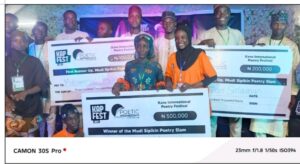
The Mudi Spikin Poetry Slam champions holding their prizes card
The Closing
BM Dzukogi, in his rejoinder for the Mina City Of Literature, wrote, “Until the last day, it seemed as though the entire weight of Kano rested on Naseeba Babale’s shoulders. Her often-cynical Facebook posts made you expect a sharp remark at any moment, but in Kano, all of that receded into the mountainous pot called KAPFEST, balanced squarely on her head. Meanwhile, Salim Yunusa, founder of Poetic Wednesdays, the art platform under which KAPFEST is held remained the calmest of all the organisers, even as the looming outcomes buried his co-curator. You will never see distress on Salim’s face, no matter the trouble. Mr. Clean was at his best as usual.”
And By 9pm the courtyard, strung with fairy lights that flickered like stars, was filled with the chatter of goodbyes between guests, participants, and the organizers. I stood, my heart nearly broken, waving at friends while motorists zigzagged around.