




By Sani Bello Hamza
Every morning, before lectures begin at Ahmadu Bello University, the aroma of freshly baked cakes drifts through the ‘’Faculty of Agriculture. Behind a modest mini kiosk, a 21-year-old Agricultural Extension student, Progress Timothy, ties her apron, mixes flour and water with steady hands, and prepares for another day of business.
Between attending lectures and responding to customers who troop in during break hours, Progress runs a growing enterprise built from scratch—one that now boasts three shops in different locations of the university.
There, in the busy faculty corridor, she mixes ingredients for cakes, pastries, and desserts while attending to classmates and lecturers who stop by for a quick bite.
She does not wait for customers to come; she creates the moment. Progress, who started the business with a little amount of money in 2023, says that today money is not her problem. “Now, money is not the problem, I don’t have a problem with money,” she says confidently, seated on a small stool inside her kiosk.

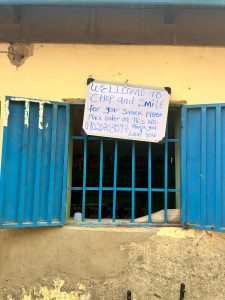
Coursemates, colleagues, and customers attested to her grit, perseverance, and good customer relations in business. “Progress is doing well, she truly embodies the motto of her business—Chop and Smile. If you chop, you will surely smile,” Auwal Dankaka, a coursemate, explains.
Laying the Foundation
Over the years, students in tertiary institutions struggle for survival in their quest to become certified graduates. They struggle to fend for themselves, cope with harsh economic realities, and study amidst these economic uncertainties. For many students, it’s a double battle: a quest to conquer their results and a separate battle to triumph over their economic needs.
A study by Ripples Nigeria shows that about 60% of students in tertiary institutions are financially insecure, thus putting students in a double quagmire of facing academic hurdles while battling for the next meal. In universities today, most students settle for the 001 meal model; the fortunate ones live on the 101 or 011 model.
This has long proven to be a daunting task for many students, thereby affecting their grades and leaving them with the option to either embrace their academic commitments and suffer financially, or hustle at the detriment of their studies—an inverse relationship and a difficult choice to make.
For many students who are willing to bail themselves out of the pitiful situation, they get stuck with no option but to survive by searching for the next person to ask for urgent 2k or the next room to knock on to beg for food.
“There are no jobs and the little we have is not enough to start a business,” a 300-level Quantity Surveying student reveals, adding that, “The amount I receive monthly is barely enough to buy foodstuffs or handouts; sometimes the money finishes a few days into the month.”
Breaking the Cycle
In the midst of this, some students are determined to break the cycle through small and subsistence businesses. Not only Progress, but other students who find themselves in business amidst academic tides explain that their lives are dependent on business.
“I can’t do without this business; it sustains me and pays my bills in school,” Abdulazeez Lawal, a 400-level Law student at ABU, reveals. Other students like Sadiya Sunusi explained that she ventured into business in school out of her passion and desire to be independent.
“I have a passion for cooking. Initially, I did it for fun, but eventually realized that I could use it to be independent. It can sustain me,” Sadiya recalled.
It is this and several other reasons that drew Progress in. She started small, backed by consistent efforts, and has now built a booming business that sustains her in school and fends for her immediate family members.
“I brought my three siblings here. I paid their school fees, enrolled them in skills acquisition centres, and paid their bills with this business,” Progress reveals. She, however, realized that she could do more, contribute, and take some burdens off her parents.
How It All Started
Before she ventured into business, Progress narrated how she struggled to cope with life. She struggled to cater for herself, pay for handouts, and eat three square meals a day. However, because she hated the fact that people have to suffer to cater for themselves and had a desire to own her own money, she launched the Chop and Smile business in 2023.

Moving forward, she became determined to use her business to put smiles on the bleak faces of students. “The aim of my exceptional business model is to see that I make people smile and happy. From the way I advertise, I do a lot of work to entertain people and captivate them,” she stated.
After baking, sorting, and packaging, Progress sometimes sits in one place to sell. She also hawks and moves from one place to another to sell. She recalled that, “It’s funny that even after having shops, I still go out to hawk because hawking gives me faster money than sitting in one place.”
Beyond hawking, Progress curates beautiful songs and staggering dance moves to hold the attention of the public. When she enters students’ reading halls, she greets them with her beautiful song, motivates them, and then hypes her product. This makes them happy and rush to buy.
It’s fascinating how she grew from earning 500–1000 naira per day to now making around fifty to sixty thousand naira after removing costs.
Despite the Success, Challenges Persist
Unlike other SMEs scouting for capital, her challenge is entirely different. For Progress, as time goes on, money is not an issue since she has three shops, but her main concern is the lack of trusted staff, and she cannot split herself into three.
Due to the sudden boom in her production, she needs helping hands—people who will assist in carrying out minor chores and manage her two shops when she is away.
Her encounter with a former assistant was not pleasant. Thus, Progress is now learning to build a transparent and accountable system that will aid in surveillance and vigilance.
“I left a lady in this shop when I travelled for a course in Abeokuta. When I came back, the shop was empty and I didn’t find anything inside. She ran away with everything. I still couldn’t reach her,” Progress soberly recounted her encounter with a former assistant.
She lamented that having trusted staff is difficult, stressing that it is you who will build a system that will make your employees accountable. Despite the odds, Progress is not deterred. She is determined to keep grinding for the development of her business and become more independent.
This is really beautiful.
It was completely true, wishing our youth to copy from her but
Students struggle to balance academics and survival in a challenging environment like Nigeria’s. It’s a constant tug-of-war between grades and making ends meet. I recall juggling opportunities during my 300L year, it wasn’t easy😪
Great job, Sani Muhammad, shedding light on this.