




By Abdulrasheed Aishah
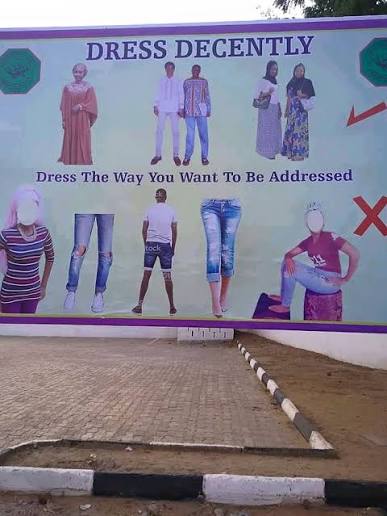
Abdul-Azeez Idris, 20, still remembers the embarrassment that nearly ruined his critical academic day as a first year student in the Department of Cyber Security at Kwara State University (KWASU), Kwara State, North Central Nigeria. It was a Tuesday morning in 2025 when he was stopped at the entrance to his lecture hall over his outfit. Security officials confronted him in full view of other students, questioning his dressing, even though he believed there was nothing inappropriate about it. He said the incident left him humiliated and frustrated.
“I was stopped at the entrance and questioned about my outfit, even though I did not dress badly,” he recalled. “The way other students looked at me as they passed by affected my confidence.” He was later asked to go and change his clothes, but by the time he returned, he had already missed a significant part of the lecture, affecting his preparation for an upcoming examination. He said the incident created unnecessary stress during an already demanding academic period.
“Although I understand that the university has a dress code policy, I believe it should be enforced with understanding,” he told The Nation Voice. “Sometimes, students are punished even when the dressing issue is minor or not clearly stated. Not every situation should attract strict punishment, especially when it affects academics.”
Regarding the school’s policy, he believes it is important but in desperate need of a review to make it clearer and more student-friendly. “My experience shows that while discipline is necessary, Universities should also show understanding, fairness, and respect when enforcing dress code,” he bemoaned.
“The punishment was too harsh”
At Usmanu Danfodiyo University, Sokoto (UDUS), North West Nigeria, Mustapha Razaq who graduated from the department of Arabic and Islamic Studies in 2025 recalls how the strict mode of dressing often became a burden, particularly for female students, though male students were certainly not exempt. “In Nigerian universities, the mode of dressing is taken very seriously, especially during lectures, tests, and examinations. [And] although female students are often more affected, as a male student, I have also experienced embarrassment due to appearance-related issues,” he recounted.
Mustapha’s most harrowing experience occurred on a particular evening when he was going to the examination hall. Dressed casually in a polo shirt, jeans, and sneakers. Due to the intense academic pressure and lack of time, he had full hair that had not been cut for weeks and slightly long nails. When he reached the examination hall, he was met at the entrance by the faculty officer who would declare his hair unkempt and refused to allow him to sit for the examination, citing a violation of the university dress code.
Despite his attempt to explain that the neglect was a direct result of academic stress – the constant ‘ups and downs’ of lectures and tests. He even promised to cut the hair immediately after the session but, despite his plea, he was sent out of the hall in front of his colleagues, an action that left him humiliated as he listened to his peers murmuring and making jokes at his expense.
When he finally walked a few miles from the examination center to a Minimart in the campus, to cut his hair, the 40-minute test period had dwindled to just 10 minutes. “At first I didn’t know until I discovered that within 8 minutes my account showed red,” he recounted. When he alerted the supervisor, the response was cold: “Don’t you know the school is closed by 6 o’clock?” This incident had left a devastating effect on his academic performance.
Sensing the tension, Mustapha was forced to quickly select any answer his hand could reach. Despite his sleepless nights and efforts to earn a distinction, he ended up with a credit in the course. He said the incident greatly affected his CGPA. “I felt the punishment was too harsh, especially since my dressing was decent and the issue was mainly about grooming.”
Crossing Into Religious and Ethical Debate
The issue of strict dress code enforcement is not limited to universities; polytechnics and colleges have also seen similar controversies. A video recently went viral on Facebook with the caption: Female students of Kaduna Polytechnic denied entry into the school premises over mode of dressing during Ramadan. The footage showed a large number of students stranded outside the school gate of the polytechnic in Kaduna State, Northwest Nigeria.
In the video, a Christian lady and several other students were shown wearing long gowns and bubu, traditional oversized dresses. Despite being fully covered, they were denied entry because the clothes had ‘short hands’. The lady in the video was visibly pained, questioning whether the move was due to the Ramadan period or other motives. The frustrated lady declared that she was ready to drag the institution for the unfair treatment.
Another alarming incident occurred at Olabisi Onabanjo University (OOU) in Ogun State, South West Nigeria, as reported by University World News on June 24, 2025. The story titled “‘No bra, no exam’ video sparks outcry about ‘harassment’” highlighted a viral video showing female students standing in line to have their chests assessed by officials – one of whom appeared to be a security guard. The officials were seen touching the breasts of students in the queue to determine if they were wearing bras, despite the school’s conduct code not containing such a specific requirement.
When students complained to the management, the university claimed they were trying to curb ‘indecent dressing’, asserting that a lack of bras could distract male students during exams. The Nation’s Voice attempted to reach Professor Umar Aliyu, the Dean of Student Affairs at OOU, but he could not be reached for comment.
The Institutional Perspectives
While students argue for empathy, university authorities defend these policies as necessary for both discipline and safety. Dr. Alex Akanmu, the Dean of Student Affairs at the University of Ilorin (Unilorin), Kwara State, North Central, told The Nation’s Voice that their dress code gives students a sense of responsibility and prepares them for their future professional lives. “Our University has value over time because it has a culture and a community that will also respect the culture,” he said while further noting that the dress code has been in effect since 2007 and was recently reviewed in 2025.
But at the Federal University Gusau (FUG), Zamfara State, North West Nigeria, the perspective is heavily focused on security. “The main reason for implementing all those rules is for security purposes and we are protecting nobody except the students,” Dr. Mu’awiya Umar Ladan, the Dean of Student Affairs, stated. He further explained that individuals could disguise themselves in niqabs, dark glasses, or P-caps to learn about the school for the purpose of an attack. But any student who is against the policy is advised to withdraw, he said.
Dr. Mu’awiya added that these rules often reflect the cultural and regional background of the university, clarifying that while the policy does not force Christians to wear hijabs, it does require all students to dress decently without exposing parts of the body that might attract men. He concluded by noting that as a federal institution, FUG is a combination of many tribes and cultures across Nigeria, and policies are reviewed collectively to ensure they remain favorable to the majority. “Many students may not know the implications of indecent dressing, but the university knows the danger,” he noted.